The traditional repro-photography set up is usually a camera mounted on a
copy stand with two lights set at 45 degree angles to the shooting surface. Usually the simplest solutions work the best.
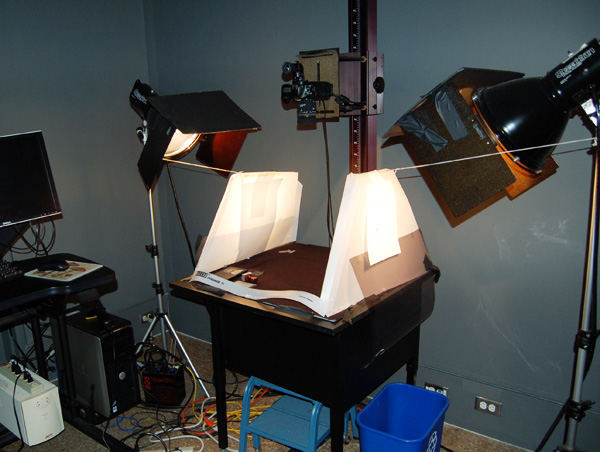
Here is our newly refurbished copy-stand at The New York Botanical Garden Herbarium:
The camera is a Canon Eos 1ds Mark II, the lights are Speedotron Black Line strobes with Chimera soft-boxes to diffuse the light and eliminate any shadows. Since this photo was taken, the camera has been replaced with a Canon Eos 1ds Mark III producing 21 megapixel shots.This set-up is a significant upgrade over its predecessor.
When I started at the Herbarium, this is what it looked like this:
This set-up was once used for specialized purposes. The lights were bare bulbs and there was a white plastic diffusion tent with top had removed and strings holding the side walls up - of course, this meant that the lights could not be moved. Unfortunately, the light was not very even. You can see where people had tried to cut the light by taping pieces of paper and neutral density filters to the diffusion tent.
We now have two stations like the one shown up top. By standardizing our two shooting stations, any special training or operator skills have been eliminated - leaving the photographers to focus their attention on the subject matter. The f-stop, shutter speed, and color balance is the same for both stations, which means that the photographer can just come in and start shooting at either station. The standardized results from the two shooting stations means that image processing and quality control goes much faster. The need to re-shoot specimens for quality reasons has been all but eliminated and productivity is up over 25%.